Greetings blogosphere.
It feels as if the school year just started, and now we're down to four weeks of classes left before semester finals. I'm not sure exactly where all the time went. And the cold weather hasn't really hit here yet (we're waaaaay overdue for our first snow of the year and we're looking at record breaking warmth this weekend) so it doesn't feel like we could possibly be on the cusp of the Thanksgiving break.
The fall musical hits this weekend at our school. And I'm not going this year (even though one of the leads is a student I've had in my class for three years now). Why? I feel overwhelmed, so much so that I couldn't even manage the details of filling out the form for my complementary tickets to the musical.
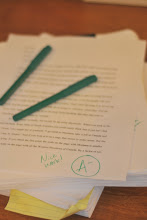
So overwhelmed that I haven't been here to write for weeks.
So overwhelmed that I haven't touched my book proposal on my dissertation since summer.
I discussed this with one of our special education teachers this week in the mail room. The special education teachers have a unique view of the school; due to their role as support system to the students on their case load, these teachers are in and out of many teachers' classrooms. This particular teacher told me that it seems like everyone is overwhelmed this year. We spent a few moments wondering about this together, and I've been thinking about this since that conversation, trying to figure this out.
Are the planets aligned just so? Are the stars broadcasting signals that are disrupting the daily existence of classroom teachers this fall? I wish it were something so innocuous.
I wonder, actually, if we're feeling the weight of doing more and more and more. Around here the abysmal budget situation has raised our class sizes. We're being bombarded across the country (even in the major movie theaters now) with the message that all the problems in education are our fault so we need to prove ourselves in the court of public opinion. Must raise test scores. Must prove our "effectiveness" (even when no one knows how to actually measure that meaningfully). Must raise standards. Must differentiate more. Must document all interventions that we've already been doing as a natural course of being a good teacher. Must do more more more more more.
Don't get me wrong. I'm not against doing many of these things we're being asked to do--like differentiating more and pushing my students toward more rigorous thinking and figuring out how to meaningfully measure my actual effectiveness in inspiring my students to be stronger readers, writers, and thinkers. But the sum effect of all of these messages is absolutely a heavy load that teachers carry around with them, a load that seems to be getting heavier and heavier.
Maybe this is why I had such a hard time transitioning back to school this year. I usually slide happily into the school year, but perhaps this year the load that I had to pick up as I walked back into the school building was edging toward too much for me to handle alongside my job that already requires so much of me to do well?
I hate calling what I do a "job." It's what I do as a human being; it's who I am. I can't imagine my life without it. But all this other stuff...
--M. Shelley
Showing posts with label balancing. Show all posts
Showing posts with label balancing. Show all posts
Friday, November 5, 2010

Sunday, January 3, 2010
New Year Thoughts
It's back to work tomorrow after a glorious two weeks off. My daily schedule has included sleeping until nine, exercising with a hike or walk or run, reading to my six-year old daughter, having time to cook lots of good food, enjoying time with friends and family, watching the season 5 X-files dvds I got for Christmas into the wee hours, and not even thinking about school.
But now that school is imminent, I'm thinking about it again.
I entered into the school year in August with high ambitions about the change I wanted to inspire at my school including a move toward 21st century teaching a learning by galvanizing a group of my colleagues around the goal, a cutting-edge partnership with the local university, a sharpened focus on just who exactly our students are and what they need to be successful in their future world. With only half the year remaining, there's been pretty much no movement toward any of these goals.
Not for a lack of trying on my part.
The problem is that the game has shifted. We are in a budget crisis upon our governor's announcement that he will cut millions from the state education budget. What that means for our school is that we are likely to lose 5 or more teachers next year. We will need to cut back on some programs. I hoped we would take this as an invitation to innovate. And a group of us met as a think tank of sorts to come up with ideas for how to look at things differently for next year.
Some great ideas surfaced, but I realized later why I left this think tank meeting feeling somewhat disheartened. The focus of the conversation was not where my mind wanted it to be: I wanted us to put our students at the center of the conversation--who are they? how do we meet their needs? how do we prepare them for a future we can't see quite clearly yet? Instead, the content of the conversation focused on saving money in a million little outside of the box ways.
So what to do? I find myself right back where I've been many times: working my influence on the small sphere that I can. That means I will focus on the change I can enact for my students in my classroom.
The issues of the greater system that I work within are so overwhelming that I just don't know where to start. I become immobilized. And frustrated.
But maybe it took this two-week hiatus to help me remember where to start, where I've always started...
...with the students who will sit in front of me once again on Wednesday.
M. Shelley
Wednesday, December 9, 2009
still here...
Seems The Paper Graders have been swamped by... well, grading papers.
It's the end of the semester--finals next week. It's difficult to pull of much more than school at this point.
Just wanted to let you know we're still here, still thinking/discussing teaching, just haven't gotten the thoughts on the screen for a while.
And now I return to the paper grading...
M. Shelley
Tuesday, September 29, 2009
Looking ahead at my focus, form, frame experiement
So F. Scott is blogging every so often about his current experiment with this focus, form, frame framework. He's got me thinking about how to apply this to one of my classes, starting next week when we launch into a new unit reading a nonfiction book together.
The thing is that this framework is very much in line with what I have been working toward as a teacher for years. I have taught very much in this way before--had my AP Lit students in a previous school coming up with discussion topics for our novels and facilitating discussions. Had my Advanced Comp students making more of their own decisions about which modes of writing to study when depending on what angle they wanted to take in responding to a particular topic. Even had them determine our list of topics for a semester.
Even in my current school where F. Scott and I teach, I started out in my first year (I'm now in my third year there) intending to do even more of the kind of teaching I had been working toward where I would involve my students in as much decision making as possible about the what, when, how of our classroom. I believe strongly that we teachers should turn over decision making to our students whenever we can in an effort to more fully engage them in what happens in our classroom. Why should I be the one spending hours with a novel or short story deciding how to engage my class in a discussion of it? Can't they do some of this work? And wouldn't they get something significant out of it?
But pulling off this model in my current school turned out to be quite difficult on many levels. The student population F. Scott is working with on this (extremely motivated advanced level students) is not the same population I attempted it with (not as motivated regular track students). There were also some issues surrounding me as a new person in the building trying to enact something that went across embedded and sometimes unspoken norms about teachers' roles, students' roles, what happens in language arts classrooms, etc. My desire to share authority with my students in my classroom in ways that would work to really engage them in what we were doing was uncomfortable for some of my colleagues.
So in short, I strayed from my roots so to speak. And F. Scott is reminding me of that.
Next week I will attempt to get back to that. I'll start off with a blank 4-week calendar, a book, and a frank discussion with my seniors about their stances toward reading in school. We'll talk about procedural display, what it looks like, why we want to avoid it, how we can inspire them to work to avoid it. I'll ask them what they need in order to want to read the book (some of them have already told me that they have read not one single book in their years of high school language arts classes). Our focus will be the text as it pertains to the big essential question for the course, the frame will be four weeks, and the form will be two-fold: a compare/contrast paper (an agreed-upon assessment for the course) and a group presentation about an issue connected to the text. Other than that, they'll have to help me figure out the details: do they want reading quizzes to motivate them to read? Do they want lots of discussions in class? When should the paper be due? How much in-class time do they want to work on it? When should we watch the film interpretation of the text (if they want to watch it)?
I really believe that just engaging them in the conversation is powerful. My dad always taught me that people have the right to a say in decisions that affect their lives. If I want my students to engage in my course in such a way that it does have some meaningful effect on their lives, don't I owe it to them to help me figure out how to make it some worth their effort and engagement?
Sunday, August 30, 2009
too much too much!
Okay F. Scott:
I was just looking through my Twitter stream and I got very overwhelmed. I follow a few educational movements (so to speak, edurati for example) and I found myself wondering how I was ever going to be able to make any sort of a contribution to any of these things. There's no time. I spent the whole day today responding to student drafts, and I didn't get them all done. Didn't make the pot of chili I planned so my family would have food for the week. Didn't pay bills (will have to do that tomorrow evening--takes me two hours usually). Didn't get the one house cleaning/organizing chore done that I had planned. Okay, I could have NOT gone to the zoo with my family on Saturday and gotten all of this done. But that doesn't work either. Family first--my husband and kiddo are more important than getting the papers read or the blog updated.
So it struck me: I want to cultivate a voice on things educational. I can't have that voice in all areas that I'd like to. So I have to pick the place and dedicate myself to it. I have to pick the outlet and make it work. Those conversations we have in the office (except for the loopy Friday afternoon ones--those are just hilarious, especially with the cast of characters that stop by the door and throw laughs at us) are significant and thought-provoking. Let's start talking regularly to an audience wider than the two of us and any hapless soul who happens to walk into our office when we're trying to solve all the problems of the world.
Is this blog the outlet? Perhaps. We have one follower. I know her. I told her about us. She's a great follower to have and will respond very insightfully when she's not totally swamped by the dissertation she's defending in a few weeks. We need to get more followers. How should we do that? I have a student who writes a sports blog and he has about 200 people who regularly read his stuff. He advertises his blog on Facebook. We might need to "out" ourselves to some people around us to get folks to start reading. Would our students care to read this stuff? Do we want to go there?
And I need to commit to a weekly blog update. I've had one rolling around in my head since last week. It's about "procedural display" and how to avoid it. Can't wait to read it, can you? :-)
Enough blabbering. I need to go to bed. See you at school.
M. Shelley
Wednesday, August 19, 2009
This is a direct response to F. Scott's most recent post:
Whereas teachers like you and I and those great idealist colleagues we work with can get burned out, disappointed, and beat down by how our idealism is constantly chipped away at by the daily demands of our job and the mountain of crap that we work around (those little cuts you describe), I believe that the idealists are the seeds and engine of change. We need to be there, working on change, one classroom, one student at a time. We need to find the time and the way to make our voices heard (which is why I will insist that we write about our professional development experiences this year--your idea for how we structure our professional development time rocks and it's an idea that should be out there for others to consider) (we will be writing about this later I am certain). We need to put pressure on our colleagues, our administrators, our district to be better--like we always push ourselves to be. We need to take a look at our week and carve out a place to do this work--one hour a week set aside to cultivate our voice and get it out there is more time than if we never did it at all.
Your post sounds a lot like where I was when I left the classroom for the new frontier of the doc program. My two years there away from the classroom showed me how much I truly belong in the high school classroom. The absence of the classroom in my life so clearly defined the space it fills in me. I need it to feel relevant and challenged. And this realization will keep me here for a very long time, regardless of all the frustrating crap that comes along with the life of a teacher in our school district.
But I will need to challenge myself every year to be better, to work more efficiently, to explore new ideas, to write about it. To imagine the possibilities for our students and make those possibilities the goal of my teaching. If I don't push myself to do this, I'll get antsy and bored.
This job--it's a life as you know. And you're damn good at it. You're thoughtful and you like your students, and you want to make sure you are doing right by them. You ask tough questions about your teaching and you really want to know how to do it better. You are an idealist--you DO imagine all the great possibilities for your students, and you believe they are possible even if they seem impossible to achieve. But I know that this kind of teaching is exhausting work.
Which is why we each need to decide for ourselves if we can and want to do it.
I'm here for good. My life has shown me, as I explained above, how much I need this work. And for my own selfish reasons, of course I would like for you to stick around. For me though, managing this work in my life means boundaries--times when I don't work and I am with my family. Times during my work week when I put the grading/planning aside and read research or do some writing. I need to think seriously about how to balance everything and be sure to carefully balance it all.
And maybe I need to find a way to steer clear of the parts of the job that make me feel bad, especially the parts that I have absolutely no control over no matter how bad they are (I'm talking here about the current issues surrounding our contract and the shady dealings of our district administration. It sucks, and I hate it, and I wish that we hard working teachers got the recognition and respect that we deserve. But the more I get caught up in the negative discourse flying around about all of this, the worse I feel.)
**********************
Today was the first day of school. Thus starts another school year. I'm full of enthusiasm and hope, excited to learn more about the teenagers I met today. I know there will be rough spots--there always are. And I'm sure I'll write about them. But for now, all is rosy.
And I attended a talk this evening at our local University--gave me much to think about. That will be the focus of my next post.
Signing off,
M. Shelley
Sunday, August 9, 2009
Close to Home
Sarah Fine's eloquent essay in the Washington Post struck awfully close to home. You can read it in its entirety at the link above, and you should. She is leaving teaching after four short years, and while so much of my professional life is quite different from her's, so much is also the same.
I most definitely do not teach in an inner-city charter school. Many of the challenges she faced are at the least lessened, if not absent, in the school M. Shelly and I teach in. We are not a charter. For better or worse, we enjoy the protection of our union. Most of our students come to school ready, if not willing, to learn. A large portion of our students are even eager for education. My administration is generally supportive of me, and I have a high degree of autonomy in teaching. I work with wonderful, talented colleagues.
So why did Fine's essay resonate so strongly for me? I too am thinking about leaving the classroom. The continual expansion of the work load (especially by things that seem to have no benefit to my students), the relentless focus on high-stakes testing (even in a very 'good' school) mandated by NCLB, and the endless flow of barriers to actually connecting with students in meaningful ways are a constant drain. It is often a life of death by a thousand cuts. No one thing puts us over the top, but the accumulation buries us.
Most importantly though, Fine hit on one of the toughest parts of teaching for me.
Teaching is a grueling job, and without the kind of social recognition that accompanies professions such as medicine and law, it is even harder for ambitious young people like me to stick with it.
While every one of my parents and community members is appreciative to my face, the continual drumbeat of anti-teacher rhetoric at every level of this society is truly draining. The same parents who thank me write letters to the editor complaining about teachers demanding higher pay (not, for the record, anything that would constitute 'high' pay- our main, and apparently unreasonable, hope, is that our salary schedule could at least keep pace with inflation, which it has never done). Our district administration continually makes decisions and discusses teachers publicly in ways that devalue or show outright contempt for both teachers and the work they do. And the rhetoric and legislation of both the state and nation reflect a lack of interest and awareness of actual teaching that is frankly painful to me.
And, Like Fine, I am ambitious. Like her friend, I want to "do big things and be recognized for them." I'd like to do them working with kids, but there doesn't seem to be a whole lot of room for that in our society.
So, I am giving thought to doing some other things. Unlike Fine, I came into teaching in my thirties, with other professional experiences behind me. It has been invaluable to have that depth and grounding of experience as a teacher, but it also continually reminds me that I have other skills. I have a choice. I'm not sure yet what exactly the next thing in my life might be professionally, and I have a family to consider in these decisions.
I will be starting my eighth year in the classroom in the next few weeks, and while I look forward to, and am sustained by, my relationships with students and colleagues, I am also wondering if that is enough. It makes me very sad, and sometimes angry. I could spend a lot of time wishing for a different world, and sometimes I do (one has to be pretty idealistic to be a teacher at all). I just wish I felt like there was something more I could do with that idealism, something that meant staying in the classroom.
F. Scott
Monday, April 20, 2009
Swamped by dissertation
I wonder how many blog posts I would have for all that I have written in my dissertation in the last two weeks?
This is just to say that that is where I have been of late instead of here: dissertation hell.
Hoping it's almost over.
M. Shelley
This is just to say that that is where I have been of late instead of here: dissertation hell.
Hoping it's almost over.
M. Shelley
Subscribe to:
Posts (Atom)